


Secure AI Customer Experience
Understanding and Addressing AI Impersonation in the Contact Center
Why AI Impersonation Matters for CCaaS Providers
Enterprises are rapidly adopting conversational AI, agent‑assist tools, and automated workflows — yet many are now encountering AI-powered impersonation risks that their existing controls don’t address.
This creates hesitation about AI-driven CX initiatives, especially in industries that handle sensitive transactions.
AI now enables:
-
Realistic voice cloning that can bypass IVR and KBA
-
AI-driven scripts that manipulate agents more effectively
-
AI assistants that can be prompted or over‑privileged, leading to unintended data exposure or actions
For CCaaS platforms, these issues translate into customer concerns about fraud, trust, and compliance, which can slow AI adoption and impact deal progression.
The Three Most Common Threat Scenarios
1. Caller Impersonation Using Cloned Voices
-
Attackers use AI-generated voices to reset credentials or update sensitive information.
-
Customer concern: “How do we stop someone who sounds exactly like our actual customer?”
2. AI-Enhanced Social Engineering Against Agents
-
LLM‑assisted callers in escalating, persuading, or confusing agents into policy exceptions, unauthorized refunds, or data disclosures.
-
Customer concern: “How do we help agents recognize when they’re being manipulated?”
3. Misconfigured or Over-Privileged AI Agents
-
Internal AI assistants may pull too much data, respond with unintended detail, or act autonomously without appropriate guardrails.
-
Customer concern: “How do we prevent our own AI from over‑sharing or taking unintended actions?”
These three scenarios account for the majority of fraud losses, agent errors, and AI-related CX risks across industry verticals.
A Simple Framework for an AI‑Safe Contact Center
Preventing PII Theft, Identity Theft, and Financial Loss
CCaaS providers can help enterprises reduce these risks by focusing on three foundational layers — a model that aligns well with your existing architecture.
Identity Abuse
Make sure the person or AI claiming an identity is legitimate, not an impersonator.
(Impersonation, takeover, synthetic ID, deepfakes)
Verifying both human callers and AI agents through techniques such as:
-
voice liveness/deepfake detection
-
stronger verification for high-risk actions
-
identity governance for non-human entities (AI agents)
Content Manipulation
Ensure the conversation's meaning is safe—detecting manipulation, deepfakes, synthetic speech, or malicious prompts in real time.
(Payments, refunds, social engineering, scams)
Real-time assessment of the conversation to identify:
-
synthetic voice patterns
-
risky or manipulative language
-
prompt‑injection-like behavior
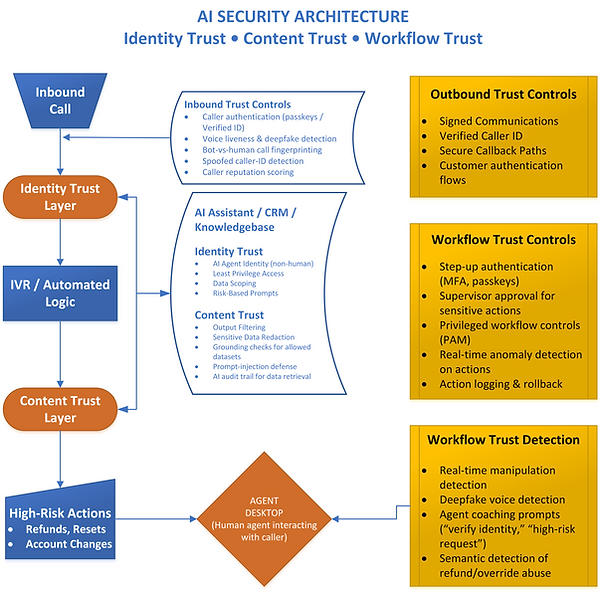
Workflow or System Abuse
Ensure that actions taken in the system—especially by AI—follow policy, have proper authorization, and cannot cause unintended harm. (Internal fraud, Business Email Compromise, AI-agent misuse, Anti Money Laundering evasion)
Guardrails that ensure sensitive actions remain safe:
-
human approval for high-value transactions
-
least‑privilege access for AI systems
-
auditing and monitoring of AI-initiated actions
This framework helps customers understand where AI impersonation risks appear — and where controls can be applied without disrupting legitimate interactions.
How Data Perceptions Supports CCaaS Providers and Their Customers
CCaaS vendors are not expected to solve these challenges alone.
Data Perceptions provides complementary expertise that fits naturally into CX transformation and AI adoption programs.
AI‑Safety Readiness Roadmap
-
A short, structured review to help customers identify impersonation and AI-related risks in their current call flows.
AI Agent Identity & Governance Guidance
-
Frameworks for treating AI agents as first-class identities with appropriate access, oversight, and safeguards.
Deepfake & Social Engineering Resilience Evaluation
-
Scenario-based analysis to help organizations understand their exposure and strengthen verification workflows.
AI‑Safe Workflow Design
-
Advisory support for securing high-risk contact‑center workflows such as password reset, refunds, and overrides.
These services are designed to help your customers adopt AI responsibly — without slowing down innovation.
Partnership Options
Your teams can engage Data Perceptions in several ways, depending on the customer’s needs:
-
Referral Partnership
Introduce us when customers raise AI‑safety or impersonation questions. -
Implementation Collaboration
Work alongside your implementation teams on AI-intensive or higher-risk CX transformations. -
Co‑Developed Customer Materials
Vertical briefs, webinars, and reference architectures to help customers understand and manage AI-related risks.
These models are designed to be lightweight and complementary to your existing offerings.
For More Information Please Contact

Eric Sundin, P.Eng


MS Video Call Link
President Consulting Services
eric.sundin@dataperceptions.com
519 279 6088
linkedin.com/in/esundin

Scott Murphy, BMath
MS Video Call Link
VP Strategic Business Development
scott.murphy@dataperceptions.com
519 279 6090
linkedin.com/in/scottmurphy